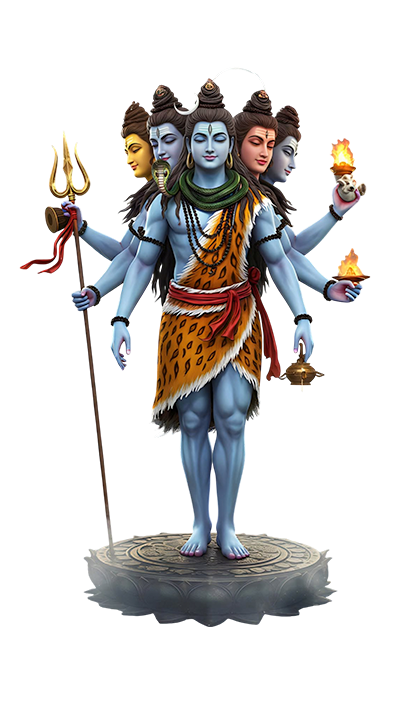
Shiv Ji represents the formless, infinite aspect of Lord Shiva—the Supreme Consciousness that transcends time, space, and form. In Sanatan Dharma, the Shivling is not merely a symbol but a sacred embodiment of creation, preservation, and dissolution—the cosmic cycle of existence.
Worshipped with deep reverence, the Shivling radiates spiritual energy and inner stillness. It invites devotees to go beyond the material and connect with the eternal truth within. The offering of water, milk, and bilva leaves to the Shivling is an act of surrender, purification, and devotion.
Spiritually, Shivling Ji is the silent witness to all that is. He is the source of inner transformation, guiding seekers toward self-realization, detachment, and divine union.
Shiva (Shiv Ji) is one of the principal deities of Hinduism, considered the Supreme Being within Shaivism, one of the three most influential denominations in Hinduism. He is revered as the "Destroyer" or "Transformer" among the Trimurti (the Hindu trinity of primary gods), alongside Brahma (the creator) and Vishnu (the preserver).
Origins and History
The history of Shiv Ji extends into antiquity, with some of his core attributes tracing back to the Indus Valley Civilization (c. 3300–1300 BCE) through figures like the "Pashupati seal," interpreted as a proto-Shiva figure.
- Vedic Period (c. 1500–500 BCE): In the early Vedic texts, the deity Rudra is associated with Shiva. Rudra is a fierce, formidable god of the wind, storm, and hunting, known for his ability to cause and cure diseases.
- Puranic Period (c. 300–900 CE): Over time, Rudra merged into the complex persona of Shiva, who is the central figure in Puranic literature. This era established Shiva's mythology, family (Parvati, Ganesha, Kartikeya), and the foundational philosophies of Shaivism.
- Modern Hinduism: Today, Shiva is worshipped across the world in diverse forms, from his iconic representation as a meditating ascetic to his aniconic representation as the Shiva Lingam.
Iconography and Symbolism
Shiva's appearance is rich with symbolism, each element representing a specific aspect of his nature:
- Third Eye: The eye on his forehead represents wisdom and all-knowingness. When opened, it unleashes immense destructive energy.
- Crescent Moon: The Chandra on his head symbolizes his control over time and his divine nature.
- Matted Hair (Jata): His matted locks are believed to contain the holy River Ganga, whose flow to Earth was controlled by Shiva to prevent it from flooding the world.
- Ashes (Vibhuti): Smearing ashes on his body signifies the impermanence of life and his ascetic nature.
- Serpent (Vasuki): The cobra coiled around his neck represents his power over dangerous creatures and immortality.
- Trishul (Trident): The three-pronged weapon symbolizes the Trimurti or the three fundamental aspects of existence: creation, preservation, and destruction.
- Damaru (Drum): This small hourglass-shaped drum produces the primal sound "Om," from which all creation is believed to have originated.
- Tiger Skin: Shiva sits on or wears a tiger skin, representing his victory over lust and desire.
- Nandi (The Bull): Nandi is Shiva's loyal vahana (vehicle/mount) and the guardian of his abode, Mount Kailash.
Forms and Manifestations
Shiva has thousands of names and forms, reflecting his multifaceted nature:
- Shankara/Mahadev: The gentle, benevolent form of the great ascetic who grants boons and is easily pleased.
- Nataraja: The cosmic dancer, symbolizing the dynamic cycle of creation, preservation, and dissolution of the universe through his divine dance (Tandava).
- Ardhanarishvara: A composite form with his consort Parvati, depicted as half-male and half-female, illustrating the union of masculine and feminine energies (Purusha and Prakriti) and the balance within the cosmos.
- Bhairava: The fierce, destructive form who protects devotees and destroys evil.
Shiv Ji's history is a testament to the Hindu belief in a complex deity who encompasses the entire spectrum of existence—from the peaceful meditator on Mount Kailash to the fierce destroyer of evil forces.